

How do we want to travel?
It’s easy to say: “Come on, let’s go traveling after I retire.”
The more we thought about it, the more possibilities came up. And every single one had a catch somewhere.
But let’s start at the beginning:
What is the best way for us to travel from 2029 onward?
That was the beginning of a whole lot of new questions with a whole lot of possible, confusing answers.
Possible answers to possible future ways of traveling:
1. With the caravan and tow vehicle
Good idea.
We already have both.
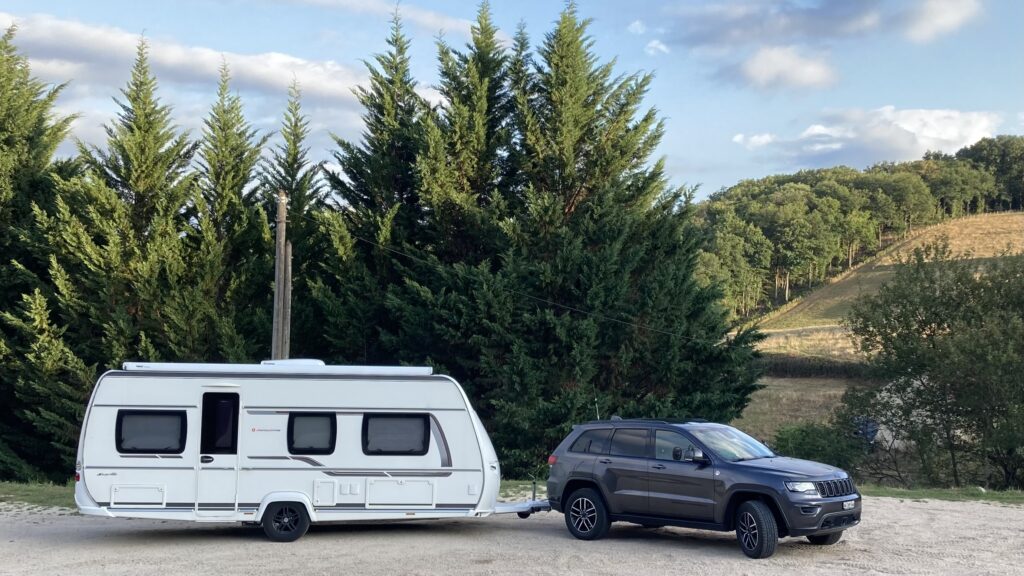
The tow vehicle … might have to be replaced because it already has more than 200,000 km (124,000 miles) on the odometer. We could buy the same model used. They don’t make new vehicles like ours anymore. Other tow vehicles, combined with my sensitivity to vibrations. That could be difficult.
Can we even find the same vehicle we have now with lower mileage and in good condition?
At least the caravan has already been adapted to our needs. With a few small modifications, it would be excellent for living in for longer periods.
What if we ship the whole rig to the USA/Canada?
How much would that cost?
Is that even possible?
What modifications would the caravan need?
How long can we temporarily import the rig?
2. Rental car + hotel
For the USA/Canada, we could travel by rental car and stay in hotels.
But how long would our budget last doing that?
Is it practical?
Is that what we want?
Checking into a different hotel every few nights.
Living out of a suitcase?
Eating out all the time. Not being able to cook for ourselves.
No real place to retreat to.
3. Buy a caravan and tow vehicle for the USA/Canada
We could do that.
There are some great American travel trailers. I’ve probably looked at several hundred of them and studied their floor plans. Some even have full bathrooms and an oven. All of that would be great.
But it would tie up a lot of money that we could use for many other things.
It would also tie us quite strongly to North America.
And — I’m getting ahead of myself here — a few weeks after we had dismissed the idea.
It’s a good thing we didn’t go down that road, because I’m almost convinced that these travel trailers are equipped exclusively with compressor refrigerators, which aren’t suitable for me because of my sensitivity to vibrations.
4. Campervan/motorhome — semi-integrated, fully integrated, or hybrid
Yes, I probably had exactly the same look on my face that you might have right now.
I’ll try to explain.
Fully integrated motorhomes are those huge beasts without a visibly separate cab.
That was out of the question for Kurt from the start.
Semi-integrated: You can probably guess. There’s a clearly visible cab.
Campervan: A converted bus/van.
Hybrid: A mix between a semi-integrated motorhome and a campervan. Basically, the “box” on the back of a hybrid is about the same width as the cab, making it more van-like.
The first thing we looked at was a campervan.
The arguments in favor of a campervan were pretty simple. It’s compact, so I could drive it too if I had to, as long as it had an automatic transmission.
Kurt did some research and found a great campervan for us.
I was already a little bit in love with it. Everything was compact, but there was still enough room for me to retreat when the fatigue and pain became too much. Easy access to the bed. Great bathroom.
We took it for a test drive.
At this point, I should probably explain that my body and certain vibrations are mortal enemies. I can’t travel by bus, train, ship, ferry, or gondola, and most test drives in regular cars had only one result: I couldn’t walk anymore, my pain level was much higher than before the test drive, and the abnormal sensations in my body were having a party and tormenting me.
None of that happened in this campervan.
I could walk — that’s always a very good sign.
Everything was great.
In our minds, we had already signed the purchase agreement.
Kurt had them show him the details.
I could already see us parked in the most beautiful places, enjoying nature.
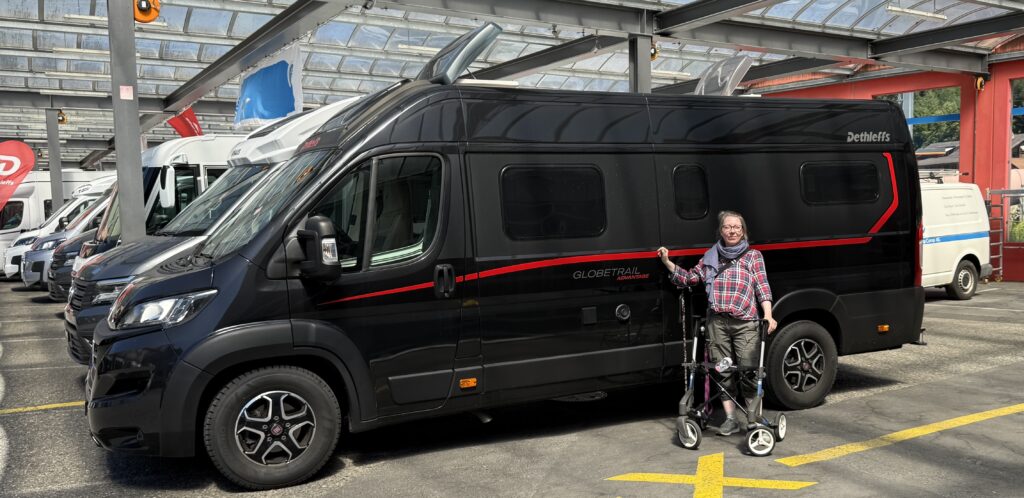
Until I asked them to please switch on the refrigerator as one final test.
Refrigerators in hotels are often my ultimate enemy — the first thing I switch off when I get into a hotel room.
The campervan had a compressor refrigerator.
Before and after the test drive, I had been walking pretty well by my standards. After the refrigerator had been running for a few minutes, even standing was a real ordeal. Walking wasn’t even something I could think about at first.
That was the end of the campervan idea.
Because basically all of them come with compressor refrigerators.
Next idea: hybrid motorhome.
Compressor refrigerator — installed in a different location. But that doesn’t change the vibrations.
… and that’s how we ended up as the proud owners of a semi-integrated motorhome. Something I couldn’t imagine for us at first, but which now seems to be the perfect motorhome for us.
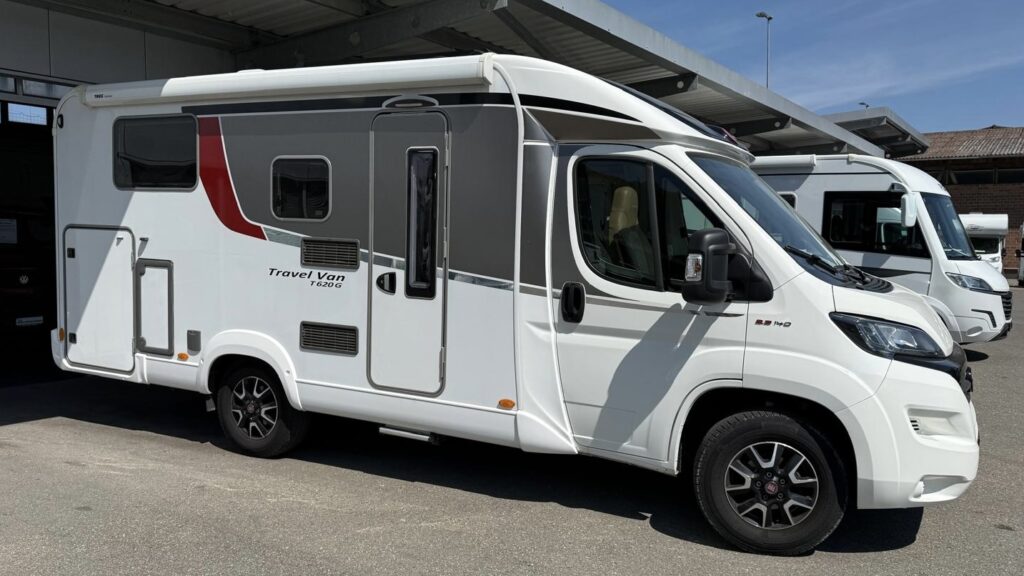
I’m looking forward to exploring the world with it.
It drives perfectly.
It has everything we need.
And it has an absorption refrigerator with no vibrations that limit me.
The featured image for this article was created using AI.